
by Patrick Burns.
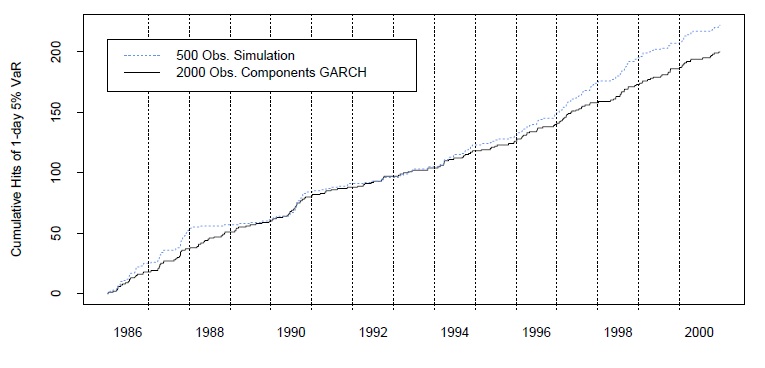
Abstract: The estimation of value at risk using univariate GARCH models is examined. A long history of the S&P 500 is used to compare these estimators with several other common approaches to value at risk estimation. The test results indicate that GARCH estimates are superior to the other methods in terms of the accuracy and consistency of the probability level. Although all of the GARCH models tested performed relatively well, the quality of the value at risk estimate does depend on which particular GARCH model is used. Weighting recent observations more heavily when fitting the GARCH model seems to be beneficial.
jun 25, 26
Music and snow. Poke my eyes out Perhaps your immediate response is: ”I’d rather poke my eyes out with a burning stick than do data analysis.” There’s a completely different [...]
jun 25, 26
Move your data analysis to a computing environment specifically designed for it. Why R and not spreadsheets? Here are three reasons: complexity graphics money Spreadsheets are easily overwhelmed. Very complex [...]
jun 25, 26
The steps taken to fix an R problem. Task To prepare for the Portfolio Probe blog post called ”Implied alpha and minimum variance”, I tried to update a matrix of [...]