
by Patrick Burns.
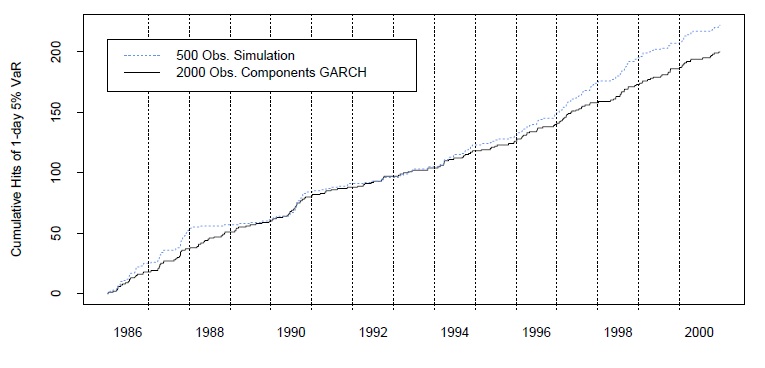
Abstract: The estimation of value at risk using univariate GARCH models is examined. A long history of the S&P 500 is used to compare these estimators with several other common approaches to value at risk estimation. The test results indicate that GARCH estimates are superior to the other methods in terms of the accuracy and consistency of the probability level. Although all of the GARCH models tested performed relatively well, the quality of the value at risk estimate does depend on which particular GARCH model is used. Weighting recent observations more heavily when fitting the GARCH model seems to be beneficial.
jun 25, 26
Towards the basic R mindset. Previously The post ”A first step towards R from spreadsheets” provides an introduction to switching from spreadsheets to R. It also includes a list of [...]
jun 25, 26
I failed to find Kahneman’s book in the economics section of the bookshop, so I had to ask where it was. ”Oh, that’s in the psychology section.” It should have [...]
jun 25, 26
An introductory comparison of using the two languages. Background R was made especially for data analysis and graphics. SQL was made especially for databases. They are allies. The data structure [...]