
by Patrick Burns.
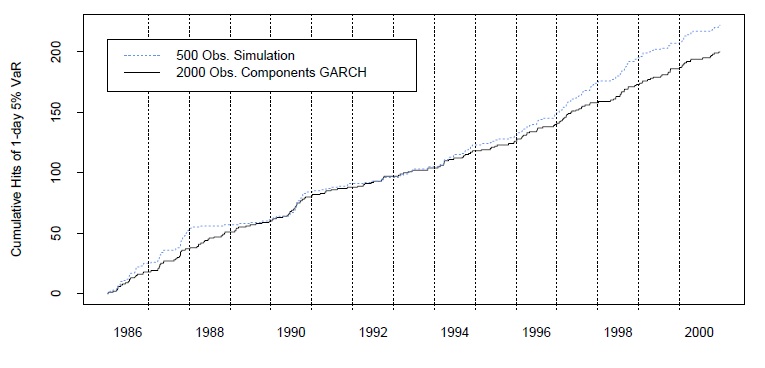
Abstract: The estimation of value at risk using univariate GARCH models is examined. A long history of the S&P 500 is used to compare these estimators with several other common approaches to value at risk estimation. The test results indicate that GARCH estimates are superior to the other methods in terms of the accuracy and consistency of the probability level. Although all of the GARCH models tested performed relatively well, the quality of the value at risk estimate does depend on which particular GARCH model is used. Weighting recent observations more heavily when fitting the GARCH model seems to be beneficial.
jun 25, 26
How to have a better chance of a good outcome. Making mistakes There’s been a lot of talk recently about data analysis problems with spreadsheets. If you’ve not stuck your [...]
jun 25, 26
The AllTrials campaign is pushing for all data on drug trials to be made public -- see the campaign statement. If the public has all the evidence rather than a [...]
jun 25, 26
Here is an interview with Ron Hochreiter, Assistant Professor at WU Vienna University Economics and Business. In 25 words or less tell us what you do (using German words is [...]