
by Patrick Burns.
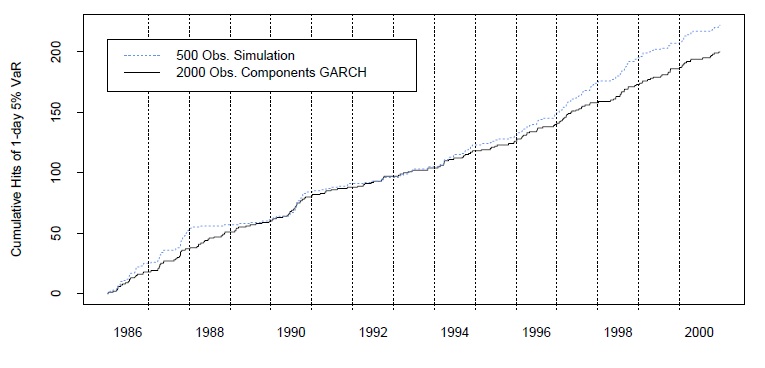
Abstract: The estimation of value at risk using univariate GARCH models is examined. A long history of the S&P 500 is used to compare these estimators with several other common approaches to value at risk estimation. The test results indicate that GARCH estimates are superior to the other methods in terms of the accuracy and consistency of the probability level. Although all of the GARCH models tested performed relatively well, the quality of the value at risk estimate does depend on which particular GARCH model is used. Weighting recent observations more heavily when fitting the GARCH model seems to be beneficial.
jun 25, 26
I’d like to do a song of great social and political import. The code that created the illustrations in Tao Te Programming is now available as the TaoTeProgramming package on [...]
jun 25, 26
Another of the all ye entering here. Issue When subscripting an xts object, columns that don’t exist in the object are silently ignored. Example First, create an xts object: xtx [...]
jun 25, 26
Posts by page views Interview with a forced convert to R from Matlab A first step towards R from spreadsheets Plot ranges of data in R A statistical review of [...]