

by Patrick Burns.
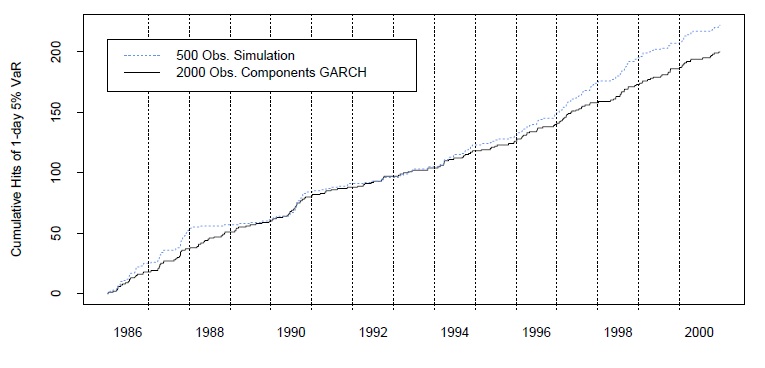
Abstract: The estimation of value at risk using univariate GARCH models is examined. A long history of the S&P 500 is used to compare these estimators with several other common approaches to value at risk estimation. The test results indicate that GARCH estimates are superior to the other methods in terms of the accuracy and consistency of the probability level. Although all of the GARCH models tested performed relatively well, the quality of the value at risk estimate does depend on which particular GARCH model is used. Weighting recent observations more heavily when fitting the GARCH model seems to be beneficial.
jun 25, 26
The function in question is scriptSearch. I’m not much for superlatives — ”most” and ”best” imply one dimension, but we live in a multi-dimensional world. I’m making an exception. The [...]
jun 25, 26
I recently gave a talk at the R in Finance conference in which I introduced the marketAgent package for R. Here is the source for the package if you'd like [...]
jun 25, 26
Executive summary Surprisingly good. And it’s not like my expectations were especially low. Structure There are 20 chapters. I mostly like the chapters and their order. Hadley breaks the 20 chapters [...]