

by Patrick Burns.
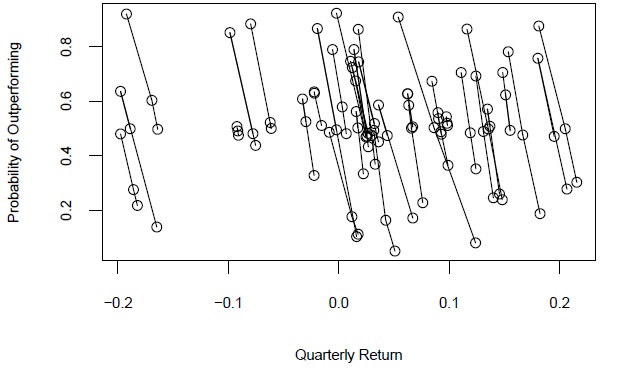
Abstract: Problems with performance measurement using information ratios relative to a benchmark are exposed. Random portfolios (that obey constraints but disregard utility) are shown to measure investment skill effectively. Investment mandates can also be based on random portfolios — this allows active fund managers more freedom to implement their ideas, and provides the investor more flexibility to gain utility. The issue of the proper attitude towards tracking error is broached, but left largely undecided. There is also a critique of Fisher’s method of combining p-values that shows Stouffer’s method to be preferable.
This version: 2004 December 02 (pdf)
A revised version of this with some additional material appears as ”Random Portfolios for Performance Measurement” in Optimisation, Econometric and Financial Analysis E. Kontoghiorghes and C. Gatu, editors. Springer.
jun 25, 26
How to have a better chance of a good outcome. Making mistakes There’s been a lot of talk recently about data analysis problems with spreadsheets. If you’ve not stuck your [...]
jun 25, 26
The AllTrials campaign is pushing for all data on drug trials to be made public -- see the campaign statement. If the public has all the evidence rather than a [...]
jun 25, 26
Here is an interview with Ron Hochreiter, Assistant Professor at WU Vienna University Economics and Business. In 25 words or less tell us what you do (using German words is [...]