

Resources
Documents and publications

Tao Te Programming
A philosophical exploration of the craftsmanship behind high-
stakes quantitative code.
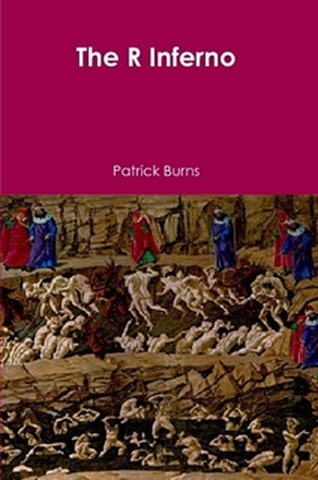
The R Inferno
Navigating the hidden pitfalls and logical circles of the R programming environment.

R packages
BurStFin
A package of functions aimed at finance, though some of the functionality can be used in other applications. The most interesting functionality is:
- estimate variance matrices when there are more variables than observations
- create 3-dimensional arrays (a specialized form of what the abind package does)
BurStFin is available on CRAN.
BurStMisc
A package of miscellaneous functions. Currently it contains:
scriptSearch: search within files in a directory (and its subdirectories). This can be seriously time-saving if you have a lot of files.corner: sort of likeheadandtailbut only returns a few rows and columns. It is useful for making sure large datasets are as you expect. It also works on higher dimensional arrays.ntile: returns equally sized groups such as quintiles and deciles.genopt: a simple implementation of genetic optimization mixed with simulated annealing.- functions to do random permutation tests (from the paper “Permuting Super Bowl Theory”).
writeExpectTest: automatically writeexpect_equaltests fortestthat.
BurStMisc is available on CRAN.
TaoTeProgramming
A package containing the code that created the art-like illustrations in Tao Te Programming.

To be added (as post cards).
The Technical Analysis Challenge – The game
You are shown 500 daily prices of an asset (an equity). The first series is:

To go with this, there is a choice of four series of 50 prices each. One of the choices is the actual subsequent 50 prices; the other three choices are randomly generated. Here are the choices for the first series:

The task is to name the extension that is the actual data. There are 100 series in all.
The pictures
There are two ways you can look at the series. The first way is to have the in-sample and the extensions separate, as above:
The other way is to have the full 550 days together:
The answers
You can check your answers with:
If you answer all 100 questions, then the picture shows the probabilities assuming pure guessing.

You need to answer at least 32 correct in order to have a p-value less than 5% for the test of being better than guessing.
You may not want to answer all the questions because some of the choices look very similar. The R command to get the p-value is:
1 – pbinom(number.correct, number.answered, p=.25)
For example if you answer 50 questions, then you need at least 18 correct to have the p-value less than 5%:
> 1 – pbinom(17, 50, p=.25) [1] 0.05512336
History
This test was done without the answers being available. The challenge ran from 2003 September 6 to 2003 October 4. The working paper “The Technical Analysis Challenge” reports the results.
Data
You can get the actual data from:
- in-sample data, comma separated with each series in a column
- extensions, comma separated with each extension in a row