

by Patrick Burns.
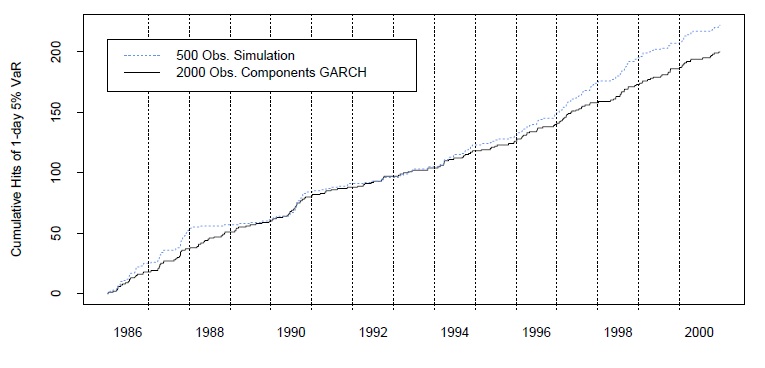
Abstract: The estimation of value at risk using univariate GARCH models is examined. A long history of the S&P 500 is used to compare these estimators with several other common approaches to value at risk estimation. The test results indicate that GARCH estimates are superior to the other methods in terms of the accuracy and consistency of the probability level. Although all of the GARCH models tested performed relatively well, the quality of the value at risk estimate does depend on which particular GARCH model is used. Weighting recent observations more heavily when fitting the GARCH model seems to be beneficial.
jun 25, 26
Several packages on CRAN provide (or relate to) interfaces between databases and R. Here is a summary, mostly in the words of the package descriptions. Remember that package names are [...]
jun 25, 26
Chapter 32 of Tao Te Programming advises you to make bricks instead of monoliths. Here is an example. The example is written with the syntax of R and is a [...]
jun 25, 26
There is a mechanism that allows variability in the arguments given to R functions. Technically it is ellipsis, but more commonly called ”…”, dots, dot-dot-dot or three-dots. Basics The three-dots [...]