

Executive summary
Surprisingly good.
And it’s not like my expectations were especially low.
Structure
There are 20 chapters. I mostly like the chapters and their order.
Hadley breaks the 20 chapters into 4 parts. He’s wrong. Figure 1 illustrates the correct way to formulate parts.
Figure 1: Chapters and Parts of Advanced R. 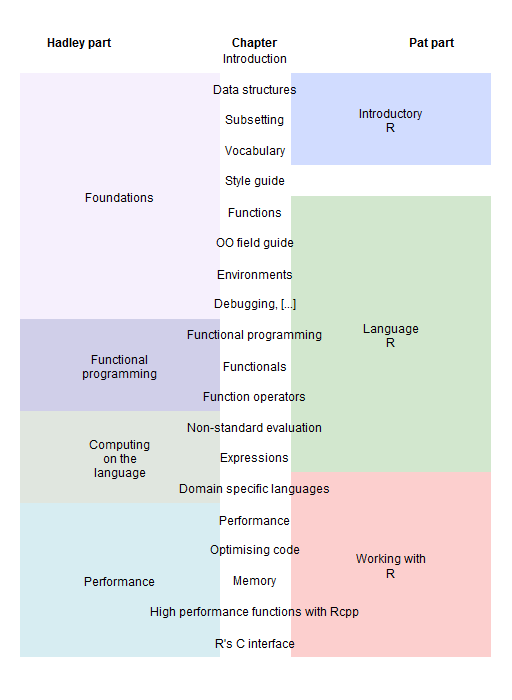
Introductory R
There are by now lots of introductions to R. There’s even an R for Dummies.
The introduction here is clean and serviceable. If you are an experienced programmer learning R, these chapters will provide you with most of the basics.
Interlude
Chapter 5 on code style is a bit of fluff that insulates the introductory material from the more advanced part. I hope most people can just about cope with there being an extra space or new line compared to their preference.
However, the chapter does talk about one thing that I think is very important: consistent naming style. Consistent naming conserves a lot of energy for users — it allows them to think about what they are doing rather than trying to remember trivia. I believe my personal best for continuous consistent naming in R is 4.3 hours of coding time. In R it’s hard.
Language R
In which the balance of the universe is partially restored.
There are lots of places that talk about what a chaotic mess R is. A book-length dose of venom is The R Inferno.
These chapters, in contrast, show the elegance, the flexibility, the power of the R language. This is the mesmerizing part of the book.
Both views are valid: the mess in on the surface, the beauty is deeper.
Working with R
Useful. But it includes the word ”work” so it can’t be all good.
Favorite sentences
R doesn’t protect you from yourself: you can easily shoot yourself in the foot. As long as you don’t aim the gun at your foot and pull the trigger, you won’t have a problem.
On speed:
R was purposely designed to make data analysis and statistics easier for you to do. It was not designed to make life easier for your computer. While R is slow compared to other programming languages, for most purposes, it’s fast enough.
On object orientation:
S3 is informal and ad hoc, but it has a certain elegance in its minimalism: you can’t take away any part of it and still have a useful OO system.
Appendix R
Here is the code that created Figure 1:
P.advanced_R_table_of_contents <-
 function (filename = "advanced_R_table_of_contents.png", seed=18)
{
  if(length(filename)) {
    png(file=filename, width=512, height=700)
    par(mar=rep(0,4)+.1)
  }
  advR.chap <- c('Introduction', 'Data structures', 'Subsetting', 'Vocabulary',
                 'Style guide', 'Functions', 'OO field guide', 'Environments',
                 'Debugging, condition handling, and defensive programming',
                 'Functional programming', 'Functionals', 'Function operators',
                 'Non-standard evaluation', 'Expressions', 'Domain specific languages',
                 'Performance', 'Optimising code', 'Memory',
                 'High performance functions with Rcpp', "R's C interface")
  advR.chap[9] <- "Debugging, [...]"
  plot.new()
  plot.window(xlim=c(0,4), ylim=c(21,0))
  hl <- 1.7
  pl <- 2.3

  if(length(seed) && !is.na(seed)) set.seed(seed)

  text(c(.5, 2, 3.5), .5, c("Hadley part", "Chapter", "Pat part"), font=2)
  rect(0, 1.5, hl, 9.5, col=do.call('rgb', as.list(runif(3, .8, 1))), border=NA)
  rect(0, 9.5, hl, 12.5, col=do.call('rgb', as.list(runif(3, .8, 1))), border=NA)
  rect(0, 12.5, hl, 15.5, col=do.call('rgb', as.list(runif(3, .8, 1))), border=NA)
  rect(0, 15.5, hl, 20.5, col=do.call('rgb', as.list(runif(3, .8, 1))), border=NA)

  rect(pl, 1.5, 4, 4.5, col=do.call('rgb', as.list(runif(3, .8, 1))), border=NA)
  rect(pl, 5.5, 4, 14.5, col=do.call('rgb', as.list(runif(3, .8, 1))), border=NA)
  rect(pl, 14.5, 4, 20.5, col=do.call('rgb', as.list(runif(3, .8, 1))), border=NA)

  text(2, 1:20, advR.chap)
  text(hl/2, 5.5, "Foundations")
  text(hl/2, 11, "Functional\nprogramming")
  text(hl/2, 14, "Computing\non the\nlanguage")
  text(hl/2, 18, "Performance")
  text((4+pl)/2, 3, "Introductory\nR")
  text((4+pl)/2, 10, "Language\nR")
  text((4+pl)/2, 17.5, "Working with\nR")

  if(length(filename)) {
    dev.off()
  }
}
The part that may be of most interest is that the colors are randomly generated. Not all colors are allowed — they can only go so dark.
jun 25, 26
How to have a better chance of a good outcome. Making mistakes There’s been a lot of talk recently about data analysis problems with spreadsheets. If you’ve not stuck your [...]
jun 25, 26
The AllTrials campaign is pushing for all data on drug trials to be made public -- see the campaign statement. If the public has all the evidence rather than a [...]
jun 25, 26
Here is an interview with Ron Hochreiter, Assistant Professor at WU Vienna University Economics and Business. In 25 words or less tell us what you do (using German words is [...]