

Main points:
- the history of random portfolios extends at least to Chicago 1965
- testing a fund versus a benchmark takes many years to get reasonable statistical power
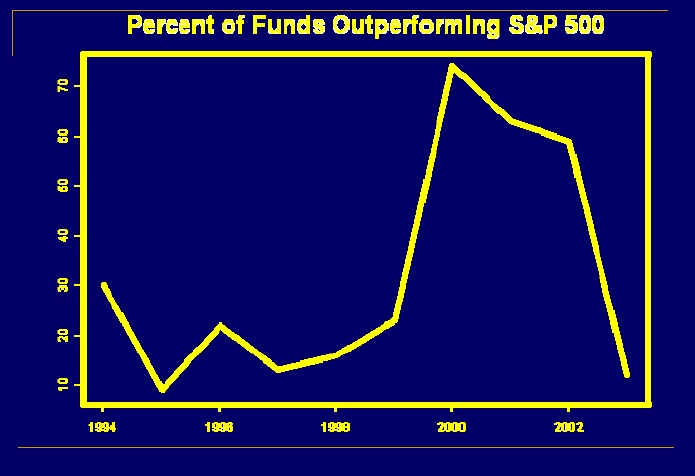
- a benchmark will be easier to beat some years versus others
- peer groups depend on the fantasy that there is little noise in the rankings of the peers
- there are open probability questions about random portfolios
- random portfolios are sometimes used like the statistical bootstrap, sometimes like a random permutation test
Presented 2009 April at the R/Finance Conference
Kommentarer inaktiverade för Random Portfolios: Practice and Theory
jun 25, 26
Several packages on CRAN provide (or relate to) interfaces between databases and R. Here is a summary, mostly in the words of the package descriptions. Remember that package names are [...]
jun 25, 26
Chapter 32 of Tao Te Programming advises you to make bricks instead of monoliths. Here is an example. The example is written with the syntax of R and is a [...]
jun 25, 26
There is a mechanism that allows variability in the arguments given to R functions. Technically it is ellipsis, but more commonly called ”…”, dots, dot-dot-dot or three-dots. Basics The three-dots [...]