

by Patrick Burns.
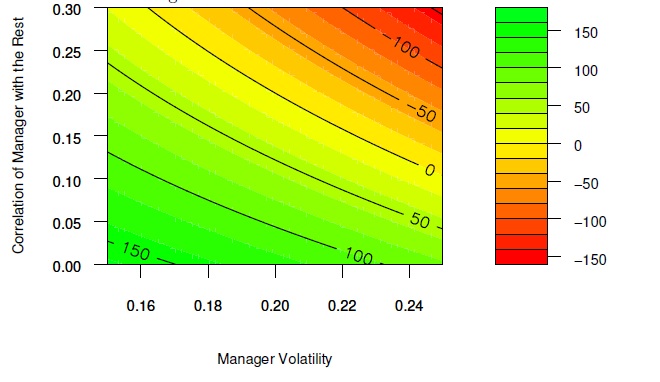
Abstract: We explore the effective gain or loss in alpha from the point of view of the investor due to the volatility of a fund and its correlations to other asset classes. Fund managers and investors can be guided by this to increase the utility that is ultimately delivered to the investor. In this analysis of investor utility, the Sharpe ratio is shown to be misleading and the tracking error has no role at all. A new class of funds — called ”hyperpassive” — is suggested which are similar to traditional index funds, but which aim to deliver a comparable expected return with less volatility than the benchmark. It is also shown that the optimal allocation to additional asset classes can be surprisingly high when the correlations are small.
This version: 2003 September 21 (pdf)
Accompanying software is available in the BurStFin package.
jun 25, 26
I’d like to do a song of great social and political import. The code that created the illustrations in Tao Te Programming is now available as the TaoTeProgramming package on [...]
jun 25, 26
Another of the all ye entering here. Issue When subscripting an xts object, columns that don’t exist in the object are silently ignored. Example First, create an xts object: xtx [...]
jun 25, 26
Posts by page views Interview with a forced convert to R from Matlab A first step towards R from spreadsheets Plot ranges of data in R A statistical review of [...]