

by Patrick Burns.
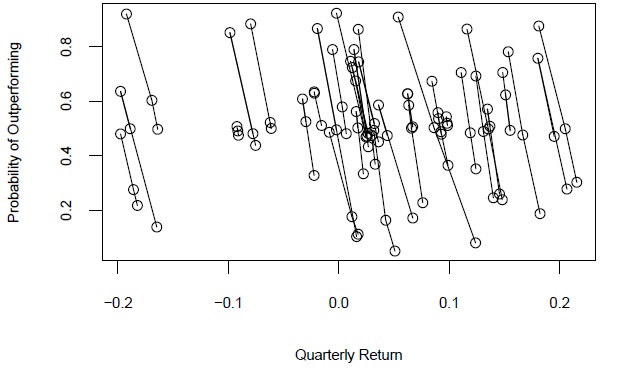
Abstract: Problems with performance measurement using information ratios relative to a benchmark are exposed. Random portfolios (that obey constraints but disregard utility) are shown to measure investment skill effectively. Investment mandates can also be based on random portfolios — this allows active fund managers more freedom to implement their ideas, and provides the investor more flexibility to gain utility. The issue of the proper attitude towards tracking error is broached, but left largely undecided. There is also a critique of Fisher’s method of combining p-values that shows Stouffer’s method to be preferable.
This version: 2004 December 02 (pdf)
A revised version of this with some additional material appears as ”Random Portfolios for Performance Measurement” in Optimisation, Econometric and Financial Analysis E. Kontoghiorghes and C. Gatu, editors. Springer.
jun 25, 26
Several packages on CRAN provide (or relate to) interfaces between databases and R. Here is a summary, mostly in the words of the package descriptions. Remember that package names are [...]
jun 25, 26
Chapter 32 of Tao Te Programming advises you to make bricks instead of monoliths. Here is an example. The example is written with the syntax of R and is a [...]
jun 25, 26
There is a mechanism that allows variability in the arguments given to R functions. Technically it is ellipsis, but more commonly called ”…”, dots, dot-dot-dot or three-dots. Basics The three-dots [...]